Story
From minerals to product
How Indonesian metal becomes a product made in North Sulawesi and shipped to Japan, Korea or Taiwan. Eight short chapters; every figure has its source and date.
Chapter 1 of 8 Indonesia keeps its ore at home
The rule: process here, or buy from those who do
Since 2014 Indonesia has closed its ore exports one metal at a time. Raw mineral ore stays in the country; processed and refined products may leave.
2014
The first ban
Unprocessed mineral ore may no longer be exported: miners must process it in Indonesia. Low-grade nickel ore (below 1.7% Ni) was allowed out again under quotas from January 2017.
Source: Law 4/2009 (Minerba); PP 1/2014 (signed 11 Jan 2014; ban from 12 Jan 2014); PP 1/2017
2020
Nickel ore closed for good
The ban on nickel ore exports took effect on 1 January 2020, two years earlier than planned.
Source: Permen ESDM 11/2019; Law 3/2020 (Minerba)
2023
Bauxite follows
Bauxite ore may not be exported since 10 June 2023. Other unprocessed ores may not leave either; concentrates only under time-limited exceptions.
Source: Law 3/2020 (Minerba), Art. 170A
2025
Copper, and no new nickel smelters
The last copper concentrate exception (Freeport, force majeure) ended on 16 September 2025. PP 28/2025 stopped new industrial licences for stand-alone plants that make nickel pig iron, ferronickel, nickel matte or MHP.
Source: Permen ESDM 6/2025; PP 28/2025
2026
The bans stay
In August 2026 the energy and mineral resources minister, Bahlil Lahadalia, confirmed that the bans remain. The national nickel ore quota was cut from 379 million tonnes (Mt) in 2025 to about 295–300 Mt in 2026.
Source: Indonesia Business Post (Aug 2026); Argus (Nov 2026)
Chapter 2 of 8 The nickel corridor next door
Bitung: the nearest large container terminal to the nickel parks
Indonesia’s nickel is mined and smelted in North Maluku and Central Sulawesi. North Sulawesi has no nickel of its own, but Bitung lies beside the corridor and faces East Asia.
Bitung
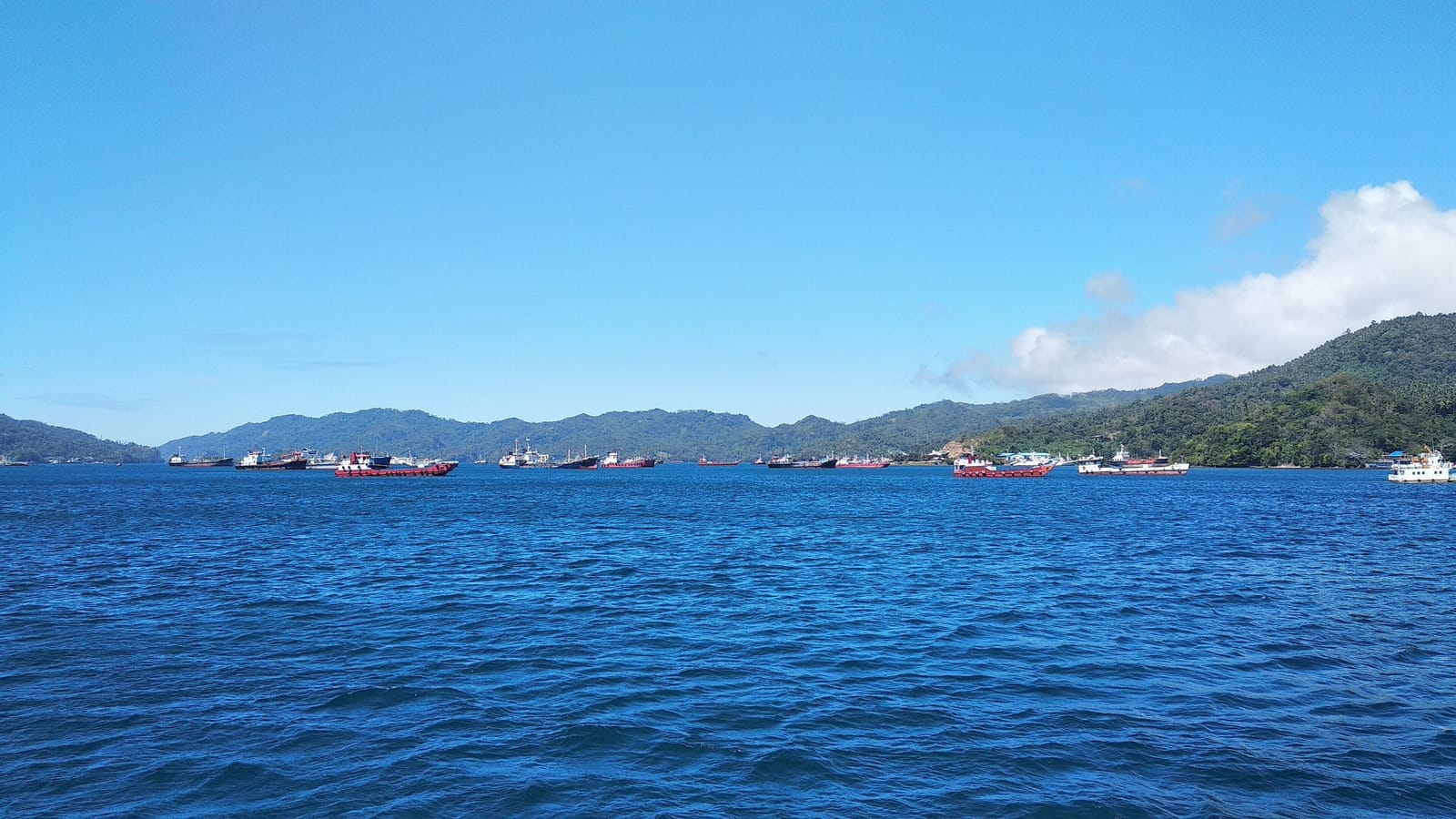
A deep-sea port in the sheltered Lembeh Strait, with the 534 ha KEK Bitung free zone beside it.
Source: PP 32/2014
Weda Bay and Obi
The nickel parks on Halmahera and Obi have their own ports, so Bitung is not their gateway. It is the nearest large container terminal: a base for fabrication, maintenance, spare parts and logistics. Weda Bay lies about 330 km away, Obi about 420 km.
Source: Straight-line (great-circle) distance, indicative
Ternate cargo
The shipping line SPIL moves North Maluku cargo between ships in Bitung. The container terminal handled 74,928 TEU (standard containers) in Q1 2025, 21% more than a year before.
Source: LogistikNews, 7 May 2025
Days, not weeks
To East Asia, a ship from Bitung sails north past the Philippines; from Java it first crosses the Java Sea. To Busan that is about 5.6 days from Bitung against 7.5 days from Surabaya.
Source: Indicative: 15 knots over the great-circle distance, no port time
Chapter 3 of 8 Cleaning mine waste
Local feedstock from cleaned mine waste
Affiliated project
ESMI, a project affiliated with the northsulawesi.org team, cleans legacy gold-mine tailings in Bolaang Mongondow without mercury or cyanide. What it recovers can feed factories in North Sulawesi.
Affiliated project
The legacy
Gold mining in Bolaang Mongondow left tailings: crushed rock that still holds metal.
The clean-up
ESMI processes the tailings without mercury or cyanide. The pilot runs from November 2026.
What comes out
Gold and silver are recovered; supply terms on request. The cleaned rock powder can go into paving blocks and bricks after leach tests.
Only after assays
Further minerals, such as titanium mineral concentrate, are offered only after independent laboratory assays confirm them. No volumes, grades or prices are published.
Supply terms depend on the pilot results and on the permit for selling associated minerals, and are agreed per contract. This is not an offer by the Provincial Government of North Sulawesi.
See the ESMI projectSource: ESMI project information, November 2026
Chapter 4 of 8 The province’s own ground
What North Sulawesi itself has, and what it can become
Gold, silver, limestone, iron and titanium sands, copper prospects and geothermal heat: the province has its own mineral base, and nickel arrives from next door through Bitung. Each row runs from ore to a semi-finished product, a component and a product.
A matrix with one row per mineral. Columns: ore, semi-finished, component, product. Rows: gold and silver, gold-mine tailings, iron and titanium sands, copper with gold, limestone and clay, geothermal heat and brine, and nickel from North Maluku via Bitung. Each row shows its status, a sourced figure and what the mineral can become.
Also reported, but without a current verified figure: manganese and kaolin (listed by the provincial mining office in 2013), pumice near Tondano, and small sulphur deposits in the Soputan, Mahawu and Ambang craters (estimated in 1974). Raw (unprocessed) mineral ore may not be exported; minerals are bought from licensed miners (IUP holders). Gold and silver are listed for completeness: they become industrial inputs only after refining.
Source: Antara, 18 May 2013; Hadian et al., 1974; Law 3/2020 (Minerba)
Chapter 5 of 8 The semi-finished step
Indonesia already makes the metal, elsewhere in the country
Large groups in Central and Southeast Sulawesi, North Maluku, East Java, North Sumatra and Kalimantan turn ore into semi-finished products. None of this metal work happens in North Sulawesi, and new stand-alone nickel smelters get no licence. What they make is the input for the next step.
Morowali (Central Sulawesi) and Weda Bay (North Maluku)
Stainless steel and nickel pig iron
Source: CREA/GEM, Feb 2026
Kuala Tanjung (North Sumatra) and North Kalimantan
Aluminium
Source: Argus, 2026
Gresik (East Java)
Cathode copper
Source: SMM, Sept 2026
Pomalaa (Southeast Sulawesi) and Obi (North Maluku)
MHP: nickel for batteries
Source: Company releases, Aug 2026
The gap
What is still largely missing is the next step: tubes, fasteners, profiles, battery packs and instruments. That last mile falls outside the smelter stop and fits a mid-sized manufacturer.
Source: PP 28/2025; research on the manufacturing page, Nov 2026

Chapter 6 of 8 The last mile in KEK Bitung
A prefab plant beside the deep-sea port
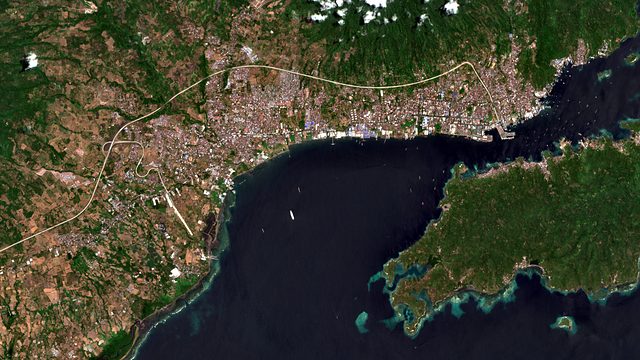
In the free zone, a steel-frame hall grows bay by bay. Below is one design from our plant configurator: metal finishing for stainless steel and aluminium.
The plot
KEK Bitung covers 534 ha. About 4.4% of its land was in use in Q2 2026, so plots are available.
Source: PP 32/2014; Zona Utara, Oct 2026
The hall
A steel-frame hall of 10,800 m² goes up in 36 prefab bays, with a warehouse and offices beside it.
Source: Plant configurator (indicative)
Power and people
About 3.3 MW of peak power, 1.4 MWp of solar panels on the roof and around 367 jobs over two shifts. The minimum wage in 2026 is Rp 4,002,630 a month.
Source: Plant configurator (indicative); Governor Decree 404/2025
Time and tax
From first permit to opening in about 15 months. Main activities from Rp 100 billion pay 0% corporate tax for 10 to 20 years.
Configurator figures are simple planning assumptions for a first conversation, not a design or a quote. No prices.
Design your own plantSource: Plant configurator (indicative); PMK 237/2020 jo. PMK 33/2021
Buildings drawn to scale from the configurator layout; the port and the surroundings are a sketch. Contains modified Copernicus Sentinel data (2026), Sentinel-2 L2A, 6 Sep 2026.
Chapter 7 of 8 Shipping to East Asia
From Bitung to Taiwan, Korea and Japan
Finished products leave through Bitung. The lanes run north past the Philippines, straight into the trade routes of East Asia.
Taiwan
Kaohsiung
About 3.6 days at sea from Bitung, against 5.1 days from Surabaya and 5.3 days from Jakarta.
South Korea
Busan
About 5.6 days at sea from Bitung, against 7.5 days from Surabaya and 7.7 days from Jakarta.
Japan
Tokyo
About 6.1 days at sea from Bitung, against 8.3 days from Surabaya and 8.6 days from Jakarta.
One lane, three markets
On average a ship from Bitung reaches these three ports about 1.8 days sooner than one from Surabaya. People and urgent parts fly direct from Manado to Seoul, Singapore and Guangzhou.
Sailing days are indicative: the great-circle distance at 15 knots, without port time or detours. Lanes on the map are a sketch of the usual passages, not a navigation route.
Chapter 8 of 8 Your route
Where do you join the chain?
Four ways in, from your access route to raw materials to a free intake call with our team.
Sources per chapter are shown beside each figure. Research status: November 2026; full research with links on request. Not legal or tax advice.